
Miniphracts part 1
This first blog post is more about the overall experience of running a small game, and is about a 2 week long game I ran in December based off of the Vanguard ruleset. I'll have much more concrete advice for people looking to do the same after I finish running my current game, which is based off of the original Cataphract. The first two sections are a summary of that game, so if you're just interested in what I learned from it, you can jump to this section.
This post will be mostly about the first Miniphracts, and as such there is no actionable intelligence for any current Miniphracts commanders.
Background
Cataphract, or Cataphracts as people often call it, is a game by San Sorensen, you can read about it more in this series of blog posts: Part 1Part 2 Part 3 Part 4 I've played in a half dozen games so far (many of them short lived ) despite the game having only been around for a year and not yet formally published.
The impetus for running "miniphracts" was Vanguard. Unlike other Cataphract games, there are a fixed number of commanders per faction, and there was at least a month between when we got the factions set up and when the game started. As I (I believe) was the only one with previous Cataphract experience, it was suggested that I run a small training exercise. This turned into a 2 week long game with a greatly pared down version of an early version of the Vanguard ruleset. I believe a different faction in Vanguard did something similar, independently.
That has since completed, and now I am running a more complete, 1 month long Miniphracts, based on the original ruleset, and incorporating things I learned from that game. While Vanguard is in many ways a very different game from Cataphract, I still think I learned a lot from that about running smaller games.
Setting up Miniphracts
I think it's good to be clear about what your goals are when you go about modifying the Cataphract ruleset and setting up a scenario. My goals were:
- To take under 2 weeks, to make sure we were done by the time the real game started
- To use only people in our faction in Vanguard, with no recruiting
- Help me understand how tanks, artillery and fuel change the game
- Help people who have never played Cataphract get used to how you think about the game
The main changes to the rules were:
- Cutting some of the more complex rules introduced by Vanguard: no airplanes, rail, road destruction, telephones, telegraphs or foreign powers
- Having only one type of stronghold.
- No boats.
- No sieges or weather. A complete map.
You can read the rules we worked off of here. It's slightly different from the Vanguard rules, as they were also refining the rules at the same time we were playing.
Making a small map
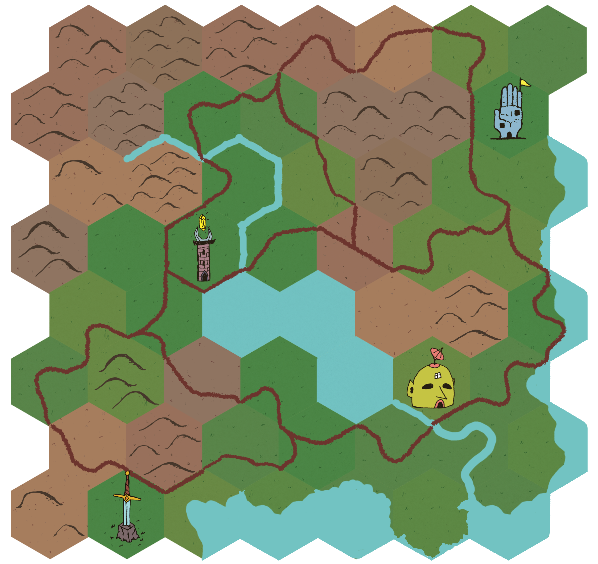
I went with 8x8, which is probably the right size for a relatively intense 2 week game. I'm actually mostly quite happy with this map. Features:
I've mostly thought about this map (and subsequent maps) in terms of circles, very approximately borrowing from dungeon design ideas about Jaquaysing and so on. This one is one big circle around a lake with four nested circles (in terms of roads). Chokepoints can also I think be interesting, but with 7-8 commanders on a small map, forcing them to spread out keeps things interesting. There are various shortcuts and other approaches that are opened up if you can go offroad.
I don't think you have to do it this way - I think chokepoints and defensible dead ends can also be interesting - but in a short game, this keeps things moving.
I'll have a lot to say about the role of terrain in a small map in a subsequent post, once I can talk about my next game.
There were 3 factions and 4 strongholds. Because everyone got a full and totally accurate map, this added in I think just the right level of incomplete information.
Faction Goals
This is something I'm still working on doing well.
I wanted something that could be achieved quickly (I very much failed at that), that gave some flexibility, but which would encourage conflict. The goals I came up with were:
- The Sword faction needs to defeat the Hand faction
- The Hand faction needs to control cities with enough fuel production (which basically amounted to needing to capture two cities)
- The Gem Tower faction must charge a toll on anyone crossing the river
I wanted unstable 3 way conflict. The Sword would obviously fight the hand, but they would have to cross the river a lot - would they be able to get along with the Gem Tower? The Hand faction needed one of the two strongholds the Gem Tower would want to control, but might not immediately know that.
What happened
Even with two weeks, a full writeup would be very long, and so I just have an extremely high level picture of the major battles here. You can read a complete, rather chaotic writeup here. This also gives some idea of how I ran the first game, although I changed a lot the next game. In particular I no longer do this level of bookkeeping to track what's happening separately from the discord.
Stage 1
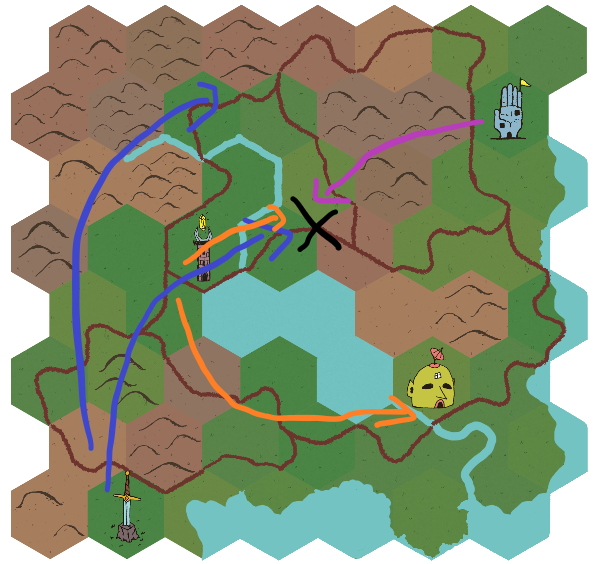
The Sword and the Gem made a sort of an informal alliance. The Hand had difficulties due to a player dropping out early on and the game not having commander recruitment. They ended up all converging just northeast of the Gem tower and then, after some attempts at intrigue and harrying, they finally clashed at the mountain pass. The Hand army won but the Sword army captured one of the two remaining Hand commanders in the chaos. Meanwhile, another Gem commander captured the Head settlement, setting themselves up for success.
Stage 2
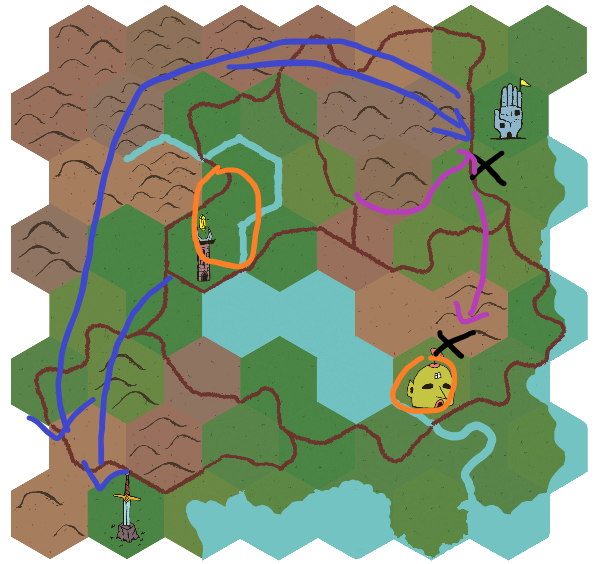
This is where I felt my goals didn't work quite as well. The Gem tried but failed to enforce the toll in the northern portion of the map, failing mostly due to miscommunication and logistical issues. It wasn't clear to what degree the Sword were actually evading their portion of the agreement, but the Gem faction was unwilling to aggressively press the issue. Meanwhile, the Hand managed to survive an attack by the Sword, defeating them after retreating back to their stronghold through the mountains then launching a counter-attack. The Sword then returned home and the Hand tried but failed to seize the Head settlement.
At this point there was not much chance of anything changing any time soon so I ended the game.
In the end, everyone achieved about half their goals. The Gem Tower controlled the river crossings but never actually got their toll. The Sword captured one commander but not the other. The Hand managed to stay alive despite some extremely bad luck so I'll call that half a win.
Most importantly, we at some point saw basically all of the game mechanics in action, so I think it was a big success in terms of understanding the game better.
Thoughts on Making Miniphracts
I'm definintely going to have more complete thoughts after running the month long one, but are the thoughts I went into that game with.
Complexity
Just adding in fuel as a second resource made this at least as much work to run as my current miniphracts, which contains a lot more rule systems overall (including recruiting). Things like weather (which I cut because I thought it would just be more mental overhead) have been way easier to run. Having two, rather than one, resource to manage is probably going to increase the difficulty of running the game more than anything.
I ended up having to basically redo all my spreadsheets a few days in to get my workflow down. Vanguard did the same, but being a much larger game, they did a pause. They also have a very large number of GMs and I was GMing solo.
Given the frequency of day 2 pauses in big games, I would recommend a lone GM incorporating this into their plans. A miniphracts game probably won't take up so much time that you need to entirely pause, but I started the current one on a Friday before a quiet weekend to give myself time to fix things live.
I would very strongly recommend setting up your spreadsheets so that every change you make is accounted for individually. I have a separate spreadsheet for tracking all resource changes by date, and every increase is linked to a decrease elsewhere (unless it's a forage or something, in which case I leave a note). This has made it much easier to notice, avoid and address mistakes, especially as I am not using automation. I was going to write something about mistakes and fixing them, but Sam just published a really good blog post on that subject, so read that instead.
Supply
One good thing about having fuel in this game is that managing fuel ended up being pivotal. The Sword faction had major problems supplying themselves with fuel and could have been in an enormous amount of trouble.
I say that because supply did not matter at all. In retrospect, it should have been obvious.
For my current game, I recalculated supply and greatly lowered the settlement scores everywhere to make sure there would be supply constraints in that game. I made a big spreadsheet of all the hexes and calculated supply by approximate region and for the entire map. This was a lot of upfront work, but it meant that supply would end up mattering, and it also made foraging really easy to track later on.
The Smallest Possible Game
This is probably it. It actually ended up being slightly less than two weeks. It took about one week to manoever into position and have The Big Battle and a second week to deal with the fallout. I think an 8x8 map where you only really do battle mechanics, no real logistics around supply, just moving around with limited information, is a pretty fun game. It's something that a lot more people could find the time to run as well. Generally I think I prefer the one month long format but I would definitely consider doing this again, and I would recommend this extremely pared down format for anyone who wants to do something quick with a group of friends. I think it would be a good way of testing certain kinds of mechanics changes as well.
The Experience of Playing the Game
I was not a player, obviously, but I think this format asks more of players. I have played games where the default order frequency is once per week, though you put in orders more often when things are actively happening. At a game of this scale, you have to put in orders every day pretty much. I was doing letter delivery multiple times a day as well - something I decided not to do in subsequent games, in part to reduce the demand on people in less compatible time zones.
The Experience of Running the Game
I was a bit worried because several of my previous games had ended in GM burnout. The amount of time and effort it takes to run is quite large, and making that sustainable has been a big topic of discussion. I think it's one of the most important things to think about when setting up a game, and is a lot of the reason why I'm spending more time working on Miniphracts and sharing what I've learned.
So that being said, I want to emphasize that running a game is extremely fun.
My favourite part is getting a front row seat to all the dramatic irony going on. In OSR games people often talk about stories dynamically emerging from player action and randomness and this is one of the best examples of that.
It's also a lot of fun to see people approach the game in different ways. Player psychology probably has as big an impact as strategy. At the same time, there isn't really a correct or incorrect way to approach the game. I saw an approach working brilliantly one time and failing terribly the next. The game is this kind of amazing chaotic dance which cannot really be predicted. It's a game where in some ways player skill does not play a huge role in the way people often think of it - I think you can be quite successful without being good at strategy games in the conventional sense - but also one in which the decisions you make do very much matter.
One of my favourite parts is how the lack of information means you get wilder, more interesting ideas, as people don't have the social pressure to do things the same way as other people. I hope that as the game and community grows, we keep that aspect of it - I already hear a lot of people hoping that they will learn how to play "correctly", or that they worry that they will play "wrong". But I think the fact that nobody really knows how to play is some of the magic of the game. In this game, as in life, you are just a small part of something larger beyond your control and comprehension, and often can't really understand or predict the impact you are having, and yet there is nothing more important than the things you choose to do.