
I ran a game set on this island twice: first using the first version of the map, and then the second. I have a lot more to day about this game; this is mostly just a dump of my game material in case it interests anyone.
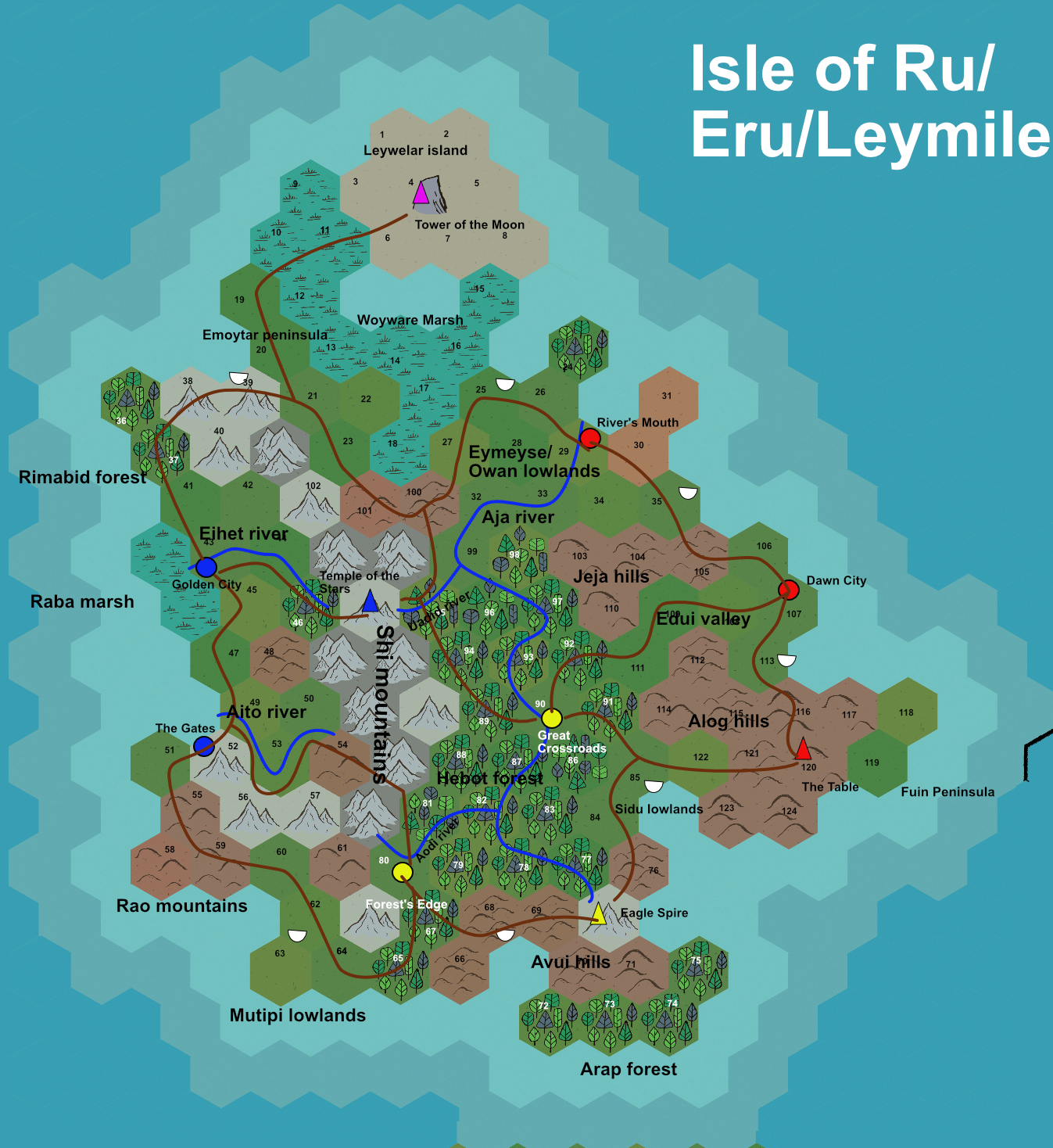
Faction Abilities
I gave everyone two special detachments and one movement or utility related ability, except for the Owl People who got an especially cool movement ability and so only got one special type of detachment.
Changes I would make:
- Missionaries do not work in a loot for morale system. I might also make the morale check happen every time.
- I would probably remove the out of formation part on takeoff, relax the supply limits slightly and clarify you're only out of formation upon landing if you immediately enter battle.
- Raiders I think were not good. I tried to make the special unit reflect how the players had played the game previously. But I think it was simultaneously too situational and also breaks a premise of the game.
Ones that worked especially well:
- The warrior-priests/noble champions lead to more risk taking by both involved factions, which I think was good.
- I really like Secret Paths as a way to make the forest feel more like the unique domain of the green-cloaks, especially in conjunction with the trappers.
- I know some people think it's boring but I think fights at 2x situationally just works well in general.
The way preferred and non-preferred traits worked was if I rolled a non-preferred trait I would substitute it with a preferred trait at random. It is possible I messed this up. Picking 5 of each was kind of arbitrary - I tried to spread them evenly though, except for Beloved, which was neither included nor excluded from anyone. I think though Crusader ended up being about as good as Beloved.
The Owl People
Preferred traits: crusader, raider, scholar, spartan, brutal. Non-preferred traits: guardian, stubborn, veteran, honorable, siege engineer
The Owl-Mask Ritual: This is a ritual that all members can do regardless of Scholar ability. Spend one day doing the ritual, during which time you are out of formation. You transform into immense flying birds. Your movement speed becomes cavalry forced march speed, you ignore all terrain except for mountains, and your carrying capacity is reduced to 3 supply. You can see 4 hexes and can be seen within 4 hexes. You can use this to bypass walls to assault a stronghold, but if you do so you cannot retreat if you lose - your army is destroyed and you have a 3 in 6 chance of capture. You count as out of formation when you land.
Bats: (skirmishers) Can see in the dark and count double when fighting at night.
The Hillfolk
Preferred traits: duelist, outrider, poet, vanquisher, honourable Non-preferred: commando, logistician, ranger, ironsides, scholar
Mule trains: Your noncombatants consume 4 supply a day but carry 100 supply, unless you’re entirely in boats.
Gold Knights (Heavy Cavalry): Knights of legend, immediately visible on the battlefield with gold plated armour. Many an army has broken and run before their charges. When attacking another army (as opposed to defending) on open terrain, they count as x6 rather than x4 combat strength.
Hill Rangers (Light Cavalry): An army consisting entirely of these moves full speed off road in flat or hilly terrain (but not forested terrain).
The Rainlands Conquerors
Preferred traits: duelist, raider, ranger, vanquisher, veteran. Non-preferred: crusader, scholar, spartan, honourable, guardian
Fortress ships These ships carry twice as much supply. Detachments in these ships gain +1 when defending.
Raiders (light cavalry): When foraging or torching, you can choose to be not out of formation, but if you do so, your forage capacity is limited to that of your raiders and wagons, and you can torch up to one hex per 100 raiders.
Noble Champions (heavy infantry): When they fight at the head of the army, they take double casualties, but treat morale as one higher, up to 9. (Same as Warrior-Priests)
The Rainlands Priests
Preferred traits: defensive engineer, logistician, ranger, scholar, siege engineer. Non-preferred: duelist, spartan, vanquisher, ironsides, brutal
Divine leadership: The first time you would cause your army to lose morale due to a forced march, you don’t. Traveling in bad weather does not count as a forced march.
Warrior-priests (heavy infantry): When they fight at the head of the army, they take double casualties, but treat morale as one higher, up to 9. (Same as Noble Champions)
Missionaries (light infantry): When they encounter an army with lower morale than them, that army must make a morale check. No morale consequences are suffered, but on a failure, a number of individuals equal to the number of missionaries defect and join as light infantry.
The Green-Cloaks
Preferred traits: commando, guardian, stubborn, ironsides, veteran. Non-preferred traits: crusader, defensive engineer, outrider, poet, ranger.
Secret Paths: Your infantry can travel along rivers through the forest as though they were roads. Your wagons float, and can travel along rivers anywhere.
Iron shields (heavy infantry): These infantry are armoured to a degree and level of craftsmanship known nowhere else in these lands. They take half as many casualties in battle.
Trappers (skirmishers): They fight as double when fighting in forested terrain.
Cut from the previous game
March-Knights (light cavalry): The vanguard of your conquering empire, they are exceptionally good at adapting to new enemies.After fighting a particular army, subsequent times, they count as 6x instead of 2x.
This was both too powerful and too annoying to track.
Relics and scholar abilities
Some notes:
- I think the raven familiar was a lot more fun for me than the player, though they died fairly early.
- I really liked Even More Secret Paths - it gave fun options without being game-defining.
- The Silver Door was a bit tricky to adjudicate, I don't think I had thought through exactly how it would work well enough.
- Nobody used the Great Horn or The Horse of the Moon across two games. - The Sword of the Gods was also great. I generally liked how abilities that have a downside that you can choose to use or not worked.
Raven Familiar
You have a raven familiar. They can do operations that a particularly intelligent and motivated raven can plausibly do at no cost, though they can only be doing one at a time. They can understand your instructions perfectly, but can only communicate in short, un-grammatical phrases with limited vocabulary. You know if your familiar has died, and it takes one day to mind link a new one.
Even More Secret Paths
Once for each of the four phases of the moon, you can step into the primeval forest, another world that runs alongside our own. The trees there are bigger, and there are no other armies, no strongholds, and no forageable land. You cannot scout while you are there. You can, however, move at forced march speed for free.
You must enter and leave it from within a forest, and you must be gone by nightfall. If you stay there, bad things will happen and you may not return.
The Horse of the Moon
When a commander uses this horse to travel alone, they can travel at night as if during the day, and in doing so, evade enemies and bandits (unless you try and run through an entire army or something.)
The Great Horn
This horn, when blown, can be heard up to 24 miles away. It is not so loud as to cause harm to those nearby, the sound just carries really really far. It resonates for a long time, however, limiting the ability to try and encode any messages in it.
The Silver Door
The silver door is contained in a large and rather bulky but surprisingly light box. It is delicate and risks being damaged if set up outdoors. Once set up, you can travel directly to the Tower of the Moon and back, to a secret location in its heart.
It is not impossible for an army to pass through, but they risk permanently damaging it and trapping some on each side. The location is also one that only you are really supposed to know about.
Ranao's Secret
The restless, vengeful spirit of Juneo speaks to you. You can know anything that you knew as Juneo. At any battlefield or any other similar source of unburied dead (e.g. a murdered commander), you can spend 100 loot to ask a question they would have known the answer to in life. This resolves as an operation.
The Sword of the Gods
While wielding this artifact, a commander can lead a battle from the front to give +1 morale (maximum 9) , but has +1 in 6 chance of risking capture. The sword glows with the light of the sun.
Public lore
The Rainlanders
The Rainlands on the west side of the mountains are the region's most populated land, with the most productive farmland, and a long history of successful conquest. Their priest-sovereign are said to be chosen by the gods. Most recently, lead by Narideo, they reconquered much of the Hebot Forest and regained some of their former glory. However, with the priest-sovereign having been killed for a second time in a year, this lead to a consolidation of power with the decidedly secular Narideo, and 10 years of political realignment and social change.
Starting Strongholds: The Gates, Forest's Edge
The Rainlands Priests In the Golden City, the former capital, a new religious movement has emerged, lead by a charismatic young priest who claims to hear the gods talk to them directly. This priest says it is time to restore the divine leadership of the Rainlands. Every day, new followers flock to them.
Starting Strongholds: Golden City, Temple of the Stars
The Hillfolk
In the rolling, dry hills in the eastern part of the island, with more herds of sheep and goats than fields of grain, come the islands's best equestarians. Ten years ago, they fought a war to avenge the Rainlands having killed their emissary, and succeeded, though they lost the often contested River's Mouth to the Owl People. They are hostile to magic, adverse to trickery, and consider one's word to be of paramount importance.
Starting Strongholds: The Table, Dawn City
The Green Cloaks
Formerly of the great Forest of Hebot, known among other things for its iron working. Last war, much of the forest was torched (technically the village grain stores - the forest is very damp) and most of the leadership killed or imprisoned. The fortress of Eagle Spire was one holdout where mot of the nobility retreated. Recently, Jopabo, who had been captured and presumed missing for years, suddenly appeared in The Crossroads and lead a revolt.
Starting Strongholds: Eagle Spire, Great Crossroads
The Owl People
The secretive, isolated inhabitants of the northern island, which they call Leywelare Island. Ten years ago, they attacked the mainland, taking over River's Mouth, and in doing so accidentally allowed Jishat Lazu, of the Hillfolk, who had gone to their island for unknown reasons, to escape with their secrets. It is now known that they have a ritual that allows them to don owl masks and fly.
Starting strongholds: River's Mouth, Tower of the Moon
Religion
There are three religions: The Gods ABove, the Twin Gods, and The Queen of the Night.
The rainlanders and some green-cloaks follow The Gods Above. The hillfolk and some green-cloaks follow the Twin Gods. The Owl People follow The Queen of the Night.
The Twin Gods
A dualistic religion consisting of the Creator and the Destroyer. The Destroyer is not evil, but both necessary and feared. Together they form cycles of life and death, day and night, summer and winter. If this cycle is interrupted, it leads to disease, famine and natural disasters.
Believers in this religion believe in reincarnation. Reincarnation is universal, impartial and neutral, and adherents are not motivated by a desire for a better afterlife. However, one’s misdeeds have a real impact on the order of the world, and more so the more powerful one is. The disruptive effect of evil can only be corrected by the death of the evildoer.
Moral Principles
Serious offenses that disrupt the natural order of the world include: Breaking oaths, including failing to defend the lands of those sworn to you Fighting someone with whom you have eaten a meal that day Violence through deception rather than honourable warfare No sorcerer or other who is knowledgeable of magic may be a king or similar ruler. Magic is dangerous, and those who wield it must always answer to someone.
While you can decide how exactly you respond to these offenses, you do take them very seriously and are earnest in your belief that they destabilize the world.
With the faith of the Twin Gods comes a series of stories about ancient heroes, and cultural values of martial achievement, courage, and the personal responsibility to avenge your kin.
The Greencloaks are typically more relaxed about sorcery than the hillfolk.
The Gods Above
The gods are many and largely anonymous, and exist in a world above the sky. Mountains are sacred, and are where the dead are buried and where priests go to commune with the gods.
The first world the gods created collapsed into chaos and evil. It was flooded with the sea. The second world was flawed, and tends towards death, decay and disorder. This is the one we live in. The third one exists above the sky, and is where the gods live.
To prevent the corruption from reaching the heavens, there is a hierarchy: the priests talk to the gods, the gods to the nobles, the nobles to the commoners. Priests should not speak to those who work the earth, to avoid the spread of corruption to the gods.
Priests help the worthy dead ascend. Evildoers, as well as those not properly buried, remain in this world to cause strife.
The Rainlander Priests hold that priests should hold both religious and temporal power, and the island should be ruled by a supreme priest, chosen by the gods.
The Rainlander Conquerors are typically less religious, but hold that the priestly hierarchy brought corruption upon themselves by involving themselves too much in worldy affairs.
The Greencloaks do not believe in a hierarchy of priests or that priests should hold political power, and are generally more relaxed about all of this.
Moral principles
An ideal society is one where all work together for the mutual benefit of all. You are all part of one big system which continues after your death, and unless you do so badly you are barred from the next world, you are all in it together. This system requires the nobility to shepherd it, and ultimately for the whole world to become aligned under it, and for everyone to play out their allotted role, but all serve all of humanity. Selflessness, cooperation and humility are valued.
The Queen of the Night
Not much is known about this faith. The owlfolk believe in many gods, but worship one in particular whose temple is deep in a mountain in their island. The symbols of the faith are the bat and the barn owl.
Secret information : You are the only one who has set foot into the heart of the Tower of the Moon. It is a strange place, full of winding passageways that go down further and further and further. You feel that if you did not wear the Feathered Crown you would get lost.
As you go down further, you get more light-headed, your mind clouds. Then, finally, you reach a statue that even with a torch you can only partially see. It moves, it speaks. It is sometimes hard to understand, but you understood what it said last time: it is time to spread your wings. It is time to take some other land for yourself.
Stronghold descriptions
River’s Mouth
Sitting on an island in the river, this town controls access to the river that winds through the center of this island, as well as the road to either side. The town consists of three parts: a keep, upstream; seaside docks surrounded by and behind stone walls; and in the middle the town proper, with a large market. One bridge to the west and one to the east link up with the road; a second bridge reaches a fortified fishing village just across on the east bank of the river.
This cosmopolitan town has changed hands between the greencloaks and hillfolk many times, before recently falling into the hands of the owl people. It is first and foremost a market town, in the middle of lush farms and teeming fisheries, where iron and wood from upriver are traded for leather and wool. It is one used to war, also, and to change.
The mayor’s name is Lord Oiduk Vuran, and he has the pleasant, carefully neutral demeanor of someone who has served many different rulers and expects to serve many more. He follows the Twin Gods.
Dawn City
The jewel of the eastern hills. A big hillfort, made of ditches and palisade walls. Its population grows and shrinks seasonally, its small round buildings used mostly in winter and in war. A small port outside the town gates mostly conducts trade, though the people here prefer to carry goods by horse than by ship.
On a higher part of a hill, stone statues of horses and sheep have offerings of flowery wreaths around them - a temple to an old religion, now converted to the Creator. One round hall, larger than the other, is decorated with colourful banners and tapestries - the home of the First of the Dawn. At the summer solstice, the sun rises between two statues: of a horse and a sheep, the lifeblood of these lands.
The mayor’s name is Mado Lazu, a distant relative of the First of the Dawn. She hates how war disturbs the regular seasonal rhythms of the town, which are enough work already. She follows the Twin Gods.
The Table
So called because it is a fort on a mesa. Smaller, older, and more strongly fortified than Dawn City, it looks out over the hills. Its walls are not that high, but the terrain is enough of a defense. It is said it was once used to watch for pirates from the southeast, though nobody has seen them in living memory. Winding switchbacks allow cavalry to be taken up here, though it’s slow going.
It contains a temple to the Destroyer, which it is said once saw human sacrifices, although that is not done any more. It’s sparsely populated and mostly administrative, though people travel to the temple to swear serious oaths, and for its repository of historical records. And, it is the place of last resort to retreat to.
The castellan’s name is Laret Tilu. While his noble family is of little martial importance, it was here before yours was and will be here when yours is gone, he would like you to know. He follows the Twin Gods.
Eagle Spire
The path to Eagle Spire runs along a long ridgeline, above the trees, and turns into a series of switchbacks and stone stairs up a sheer rock face. Horses must be dismounted and left at the bottom; a secondary fortification houses the location’s cavalry and wagons, though the road there is treacherous also for horses not used to it. The road also runs around the fortress and snakes down to the river (not shown on the map); another secondary fortification controls a large iron gate blocking the road.
The tower overlooks the ocean and the forest around it. There is a temple to the Twin Gods here, in a small forest grove transplanted within the fortress. Once sparsely populated, after the defeat of the green-cloaks last battle, it has gotten crowded, with new construction piled on top of each other and more secondary forts on the mountainside.
The castellan here is Aivi Tlird, who is also the priest to the Twin Gods. They are fatalistic and tired. They have had to learn a lot about engineering the last ten years.
The Crossroads
A large market town, surrounded by palisade walls and wooden towers, made of large stout logs too thick to easily burn. The river runs though, with a large wooden boom to block boat traffic - either to tax it, or in times of war. So does the road, over a bridge in the middle. The previous Rainlander garrison’s heads are on pikes along the outside of the wall.
Inside, it’s clear times have been hard. Once vibrantly painted buildings are faded. On market days, many of the stalls are empty. In some taverns, toasts are raised to independence; in others, a sense of unease as the townsfolk dread the devastation another war will bring.
The castellan here is Aodehea. She seethes with quiet rage at the occupying Rainlanders, but hit that behind a smile while they were still here. She follows the Twin Gods, but maintains the rainlanders’ version is heretical.
Forest’s Edge
A palisade wall fort on a hill. With the immense Mt. Rujunud looming over it, and the dense forest around it, it feels gloomy and isolated, its people like ants on an anthill. But, backed up against the cliff face on one side, the forest on another, and the river on a third, it is hard to attack.
There is a bridge over the river at the base of the hill; boats can moor at the bottom, though they are undefended. A temple to the Gods Above can be reached through a winding path up the cliff face, as far up the mountain as it would go. The cultural influence of the Rainlands, always strong, has strengthened these past ten years, though perhaps there are those who remember fondly a time without them. The economy, even in times of peace, is almost entirely based around war, and the air is often thick with smoke from the forges and smelters.
The castellan here is Najetu. He has a reputation for ambition and politicking. He’s from The Gates.
The Gates
It sits between a sheer cliff and the sea. A pair of walls and an immense gate block the road as it passes through; a smaller wall runs along the seashore inside the town. It is one of the few strongholds that have a port that is accessible from inside the city walls.The rest of the city is made up of stone structures on terraces carved into the mountainsides. Much of the nobility of the rainlands lives in the upper terraces, where elaborate marble carvings illustrating their families’ history gleam in the sun. Merchants live in the lower terraces, each roof being the road and storefront of the layer above them. In wetter months it is the last major sheltered port before ships must brave the storms to the southwest.
The castellan, Uigehao, who is only responsible for the gates and the port, always seems extremely busy, followed by aides with bundles of counting-sticks.
The Golden City
While a low stone wall rings the city, its defenses are more natural than anything, as it is mostly in a marsh, with every approach other than the road has been removed and a moat of particularly dense and treacherous mud has been cultivated. A large stone palace on a hill in the center, its roof covered in gold and its gleam visible everywhere.
Most buildings are wood, however, many on stilts. For armies, it is campaign season, but for ordinary people, it is fishing season, and the town is busy with tiny boats going to and fro, trying to get as much of the sea’s bounty before the storms return.
A large road leads out, lined with columns: the Holy Road that leads to the Great Temple of the Star. Two other gates are mostly for fishing boats.
The castellan, Ishui, is largely uninterested in anything outside the city. The war is largely an inconvenience during an economically important month of the year.
Temple of the Stars
A winding, treacherous path up the mountains rewards pilgrims with the best view on the island.
The temple proper, carved from a single rock, only allows priests inside, but satellite temples surround it. Pilgrims come from throughout the Rainlands to the place where they are closest to the gods, and a maze of temporary accommodations have sprung up on the plateau around it. It is an especially important place for funerary rites.
More recently, a large stone wall was added - some say it was foolish, as who would attack the holy city? But ten years ago, someone did.
A large statue to Juneo has been added, in the hopes of placating his angry spirit. This chaos, some say, is because he was denied proper funerary rites and so his angry spirit has cursed the Rainlands.
The castellan, Eane, mostly relays messages for Akehat, the head priest of the temple. He is stiff and formal.
Tower of the Moon
This tower is carved into the mountain itself, standing as an immense stone cone in a large, rocky plain. Steps wind up the hill, going past small slits that show flickers of movement inside, somewhere deep in the mountain.
When the gates open, like a pair of wings unfurling, behind you see a round stone hall. A marble staircase leads up to a large dais, in white marble like a mirror image of the moon; large enough for an army to assemble, and presumably take flight. Others lead downwards, to the bulk of the stronghold, a cramped and dimly lit warren decorated with endless frescoes of immense birds. Your soldiers stick close together as the people of the stronghold watch from the shadows through their feathered cloaks and masks, ducking out of sight when anyone gets too close. Much of the place seems abandoned, and as you go further down, much of it seems like it was abandoned for a very long time. Some of it seems likely to collapse. It seems someone could really get lost in here.
Notably absent is any sort of temple or sign of the god that it is said the Owl People worship. Niches in the walls, however, are conspicuously empty.
The castellan's name is Oceymis, and they seem very nervous and vaguely confused, as though they are very new to this job.
Posted November 13, 2026